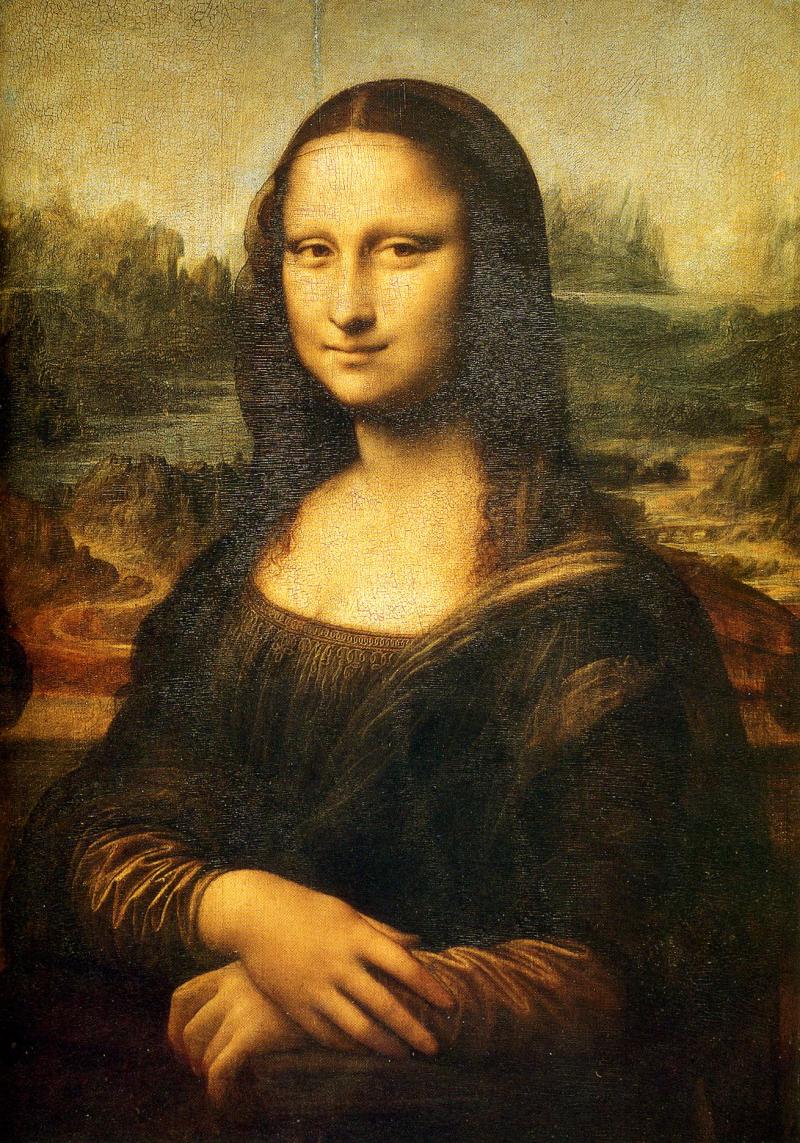
The Mona Lisa
http://portraitxpress.files.wordpress.com/2008/10/mona-lisa.jpg
Throughout time, the Mona Lisa Portrait has been observed, analyzed, and discussed. The most prevalent question is who is she and why did Da Vinci decide to paint her? There have been many theories and speculations. She could be an old friend, an old lover, or perhaps someone that just caught his attention with her mysterious smile and captivating features. Yet, others have observed that she could in fact be a man. Even further, this man could be a self portrait of Da Vinci himself. People have seen the similarities between his old features and her rejuvenated ones. He could have painted over his age with youth and a cover identity. This could be the reasoning behind the secretive smile. Since Da Vinci is long gone, no one could ever really know the truth, which keeps the critical thinking behind this picture ongoing. As people speculate further, they will come to their own conclusions and answers about the Mona Lisa, and perhaps be able to prove some of these theories in time.
Here is a picture collaberating Mona Lisa and Da Vinci:
http://www.jossefordart.com/art_journeys_and_conversa/images/MonaLisa_DaVinci-1.jpg
Saturday, May 9, 2009


Blogs to follow
For Fun:
http://www.twilightblog.net/
- who isn't getting involved in the Twilight obsession? Here's ways to follow what is going on with the series, actors, and movies.
Informative Blog:
http://www.5hourenergy.com/blog/2008/07/20-ways-to-stay-awake.html
- especially since its finals time, this could be really helpful for every student!
http://www.twilightblog.net/
- who isn't getting involved in the Twilight obsession? Here's ways to follow what is going on with the series, actors, and movies.
Informative Blog:
http://www.5hourenergy.com/blog/2008/07/20-ways-to-stay-awake.html
- especially since its finals time, this could be really helpful for every student!
Critical Thinking
Critical thinking is the ability to analyze, process, and come to a conclusion or answer to any given information. Many people use critical thinking to persuade others to their opinions about either a controversial issue or open ended question. Through critical thinking, a person is challenged to reach into the depths of their minds, and research topics to truly understand the information. Some people use critical thinking to justify actions. For example, the idea of utilitarianism believes that doing something back for the good of the whole is acceptable. Others think differently about the situation and cannot use that idea as justification. In terms of real life, the controversy of dropping the Hiroshima bomb had been critically thought about by politicians, media figures, and citizens of the world. When the United States dropped the bomb, it meant saving future lives of Americans and soldiers, as well as acting as a probable end to the war. However, it also meant killing thousands of innocent people and causing harm to the country and defects to future generations. Through critical thinking, we came to the conclusion that dropping the bomb would best suit the situation.
Since we have been in elementary school, we have been pushed to begin critically thinking. Simple questions such as, why can’t animals talk, and religious questions such as, what is right and wrong, made us think beneath the surface of issues. In middle school, we began reading books with hidden symbols, meaning and themes. This is when most children begin to analyze texts and come to conclusions about what it means in reference to the book as a whole. However, as high school and college students, critical thinking took on a new meaning. It no longer only revolved around answers that had already been concluded with scientific evidence and empirical data, but allowed students to think about their own interpretations and meanings. Critical thinking is the basis to accepting and refuting opinions, as well as helping people learn more about issues and information.
Since we have been in elementary school, we have been pushed to begin critically thinking. Simple questions such as, why can’t animals talk, and religious questions such as, what is right and wrong, made us think beneath the surface of issues. In middle school, we began reading books with hidden symbols, meaning and themes. This is when most children begin to analyze texts and come to conclusions about what it means in reference to the book as a whole. However, as high school and college students, critical thinking took on a new meaning. It no longer only revolved around answers that had already been concluded with scientific evidence and empirical data, but allowed students to think about their own interpretations and meanings. Critical thinking is the basis to accepting and refuting opinions, as well as helping people learn more about issues and information.
Greatest Day of My Life
Prelude:
It took me a while to figure out what to write about. Usually I find assigned essays the easiest to write because I can ramble about mostly anything. However, since the assigned topic happened to be “the greatest day of my life” I had a bit of an issue. I tried thinking back on previous days, starting from some of my first memories. Preschool, elementary school, middle school, then eventually high school days floated through my mind. None of them stuck out as THE best day. I’ve had good hours within different days throughout the eighteen, almost nineteen years of my life, but never consecutive 24 straight hours of pure happiness. And then the thought that I’ve lived on this planet for that long and can’t even think of the best day of my life depressed me. Thus, I’ve been avoiding writing this essay and started reevaluating my life. It seems like an easy enough process, just to think about yourself. But it’s not. It’s actually terrible. Well, maybe I’m going too far to say terrible. It’s not like I’m a depressed person. Or have any truly horrible memories. Further thinking about it, I can’t think of the worst day of my life either. But it’s also not like I live an unchanged or unchangeable life. In my opinion a day doesn’t start and end the same way. Days live on a balance scale; they can either be particularly good, or particularly bad. Either way, when I wake up from a satisfying night of sleep, whether I’ve had a dream or a nightmare, the day has the potential to be great. Knowing about this prospective greatness is very fulfilling because anything could happen. Sure that’s a very cliché statement, but really, whoever thought of it had it right. Furthermore, wouldn’t it be sad knowing that the greatest day of my life had already passed me? I do still have another 60 or 70 years to live through, and if they were all destined to be sub-par, that truly would be dreadful. So through my evaluation, I realized that the greatest day of any life can’t be just one day. But they can be based on excellent moments- through events, conversations, or even feelings.
Event:
To go through every event that I think can qualify as great would take pages and years, therefore, I’ll share just one (but keep in mind this is not the GREATEST event within all my events, because I could not just pick one).
Empty Rockstar energy drinks were lying helplessly on the car rug. Since me and Liz hadn’t been thinking in our best interests on the car ride down, chugging them in the first fifteen minutes we had been on the road was a bad idea in retrospect. Dead stop traffic was preventing us from making any progress towards an exit, or better yet, a bathroom. We realized we wouldn’t make it to the concert due to bursting bladders if action was not immediately taken. Thinking it was a good idea at the time, Liz ran out of the car to the tree and bush area and just went there. I proceeded to do the same when she got back. Neither of us cared about the cars that laughed at us when we passed, or that when one of us was gone, the car would inch up a bit and it took an awkward minute to rediscover where it had moved. But once we were reunited, we saw what had happened. Since we had run into about the same area, both of our legs had been scratched up by little thorns that had seemed insignificant at the time. They weren’t the type of scratches that just leave white marks, which just look like dried skin. It looked more like the little raptors from Jurassic Park found us and ambushed us in the five minutes we were away from the car. We aren’t the type of girls that freak out over a little bit of blood. We took the situation quite the opposite way. Thinking about the concert we were going to brought hysteria to the car. It was impossible to stop laughing once the irony was discovered. We were going to the Warped Tour, which is an “emo or screamo” full day concert. Neither me nor Liz fit in either of those categories, but share the taste in the actual music. But now it just looked like we were cutting ourselves to fit the part. When we finally did get to the concert no one was staring at our legs, or secretly commenting about the sad and pathetic girls who looked like they just played with a Swiss Army knife. I doubt anyone even saw, which made our concern that we would be judged even more hilarious. It is safe to assume that neither of us stopped on the side of the road since though.
Conversation:
Dinner conversation is meant to be polite, informative, and witty. There are lots of faux-pas involved within these types of conversations. Such involve uncontrollable laughter, lack of volume control, and exclusion or seclusion. Fortunately, when its two friendly families put together through the unbreakable bond of their daughters, these rules no longer apply. The table was full with two sets of parents, three best friends, and three younger siblings. While the parents were involved in their own discussions about current events, the taste of the wine, and how destructive the children had been thus far on vacation, my twin best friends and I were delusional. It was around the fourth day we had been in Las Vegas, and our constant activeness tied with the lack of sleep we had, created a mindset none of us had ever reached before. Pure exhaustion mixed with good temperaments made us actually insane. I could not even recall what most of the conversation revolved around, but at one point the three of us thought we had seen penguins. Laughter filled the restaurant and could not be broken by the neighboring diners death staring us or the parents scolding us to simmer down. Our younger siblings thought we were just crazy, and had always thought that, thus not being phased. It’s a good thing we didn’t care what other people thought about us because if anyone had been listening in to our dinner conversation we might have been banned from all future dinner parties, because it’s apparent our type of friendship will never change.
Feeling:
Waking up to an alarm clock everyday becomes a dreaded fact of life. There is nothing more annoying to me then the obnoxious beeping that directly enters my ears. But what’s even worse is knowing the alarm clock is going to go off and waking up before it actually does. Sometimes that’s beneficial, but it seems that any time I don’t actually need to wake up, I do for the sole reason that I know, or think I know, that my alarm is going to ring. These cases of annoyance occur mostly on the weekends. Furthermore, the clock that ticks inside me doesn’t mind waking me up early on a snow day. But these are the sole times I don’t mind it either. When I look outside I see what I imagine peace to look like, a fresh blanket of pure snow covering every inch of the earth. Everything is untouched. There is a fire blazing in my living room. The crackle adds an appropriate soundtrack. It’s comfortable. Whether the house is cold, a blanket is always close by to snuggle into. There is tea or hot chocolate available in the cabinets. These drinks allow my stomach to thaw out and wake up. There is no need for an alarm clock on these days. I’m no longer tired when I see what the night has brought me. This is a feeling of true content. This is what makes a moment great.
It took me a while to figure out what to write about. Usually I find assigned essays the easiest to write because I can ramble about mostly anything. However, since the assigned topic happened to be “the greatest day of my life” I had a bit of an issue. I tried thinking back on previous days, starting from some of my first memories. Preschool, elementary school, middle school, then eventually high school days floated through my mind. None of them stuck out as THE best day. I’ve had good hours within different days throughout the eighteen, almost nineteen years of my life, but never consecutive 24 straight hours of pure happiness. And then the thought that I’ve lived on this planet for that long and can’t even think of the best day of my life depressed me. Thus, I’ve been avoiding writing this essay and started reevaluating my life. It seems like an easy enough process, just to think about yourself. But it’s not. It’s actually terrible. Well, maybe I’m going too far to say terrible. It’s not like I’m a depressed person. Or have any truly horrible memories. Further thinking about it, I can’t think of the worst day of my life either. But it’s also not like I live an unchanged or unchangeable life. In my opinion a day doesn’t start and end the same way. Days live on a balance scale; they can either be particularly good, or particularly bad. Either way, when I wake up from a satisfying night of sleep, whether I’ve had a dream or a nightmare, the day has the potential to be great. Knowing about this prospective greatness is very fulfilling because anything could happen. Sure that’s a very cliché statement, but really, whoever thought of it had it right. Furthermore, wouldn’t it be sad knowing that the greatest day of my life had already passed me? I do still have another 60 or 70 years to live through, and if they were all destined to be sub-par, that truly would be dreadful. So through my evaluation, I realized that the greatest day of any life can’t be just one day. But they can be based on excellent moments- through events, conversations, or even feelings.
Event:
To go through every event that I think can qualify as great would take pages and years, therefore, I’ll share just one (but keep in mind this is not the GREATEST event within all my events, because I could not just pick one).
Empty Rockstar energy drinks were lying helplessly on the car rug. Since me and Liz hadn’t been thinking in our best interests on the car ride down, chugging them in the first fifteen minutes we had been on the road was a bad idea in retrospect. Dead stop traffic was preventing us from making any progress towards an exit, or better yet, a bathroom. We realized we wouldn’t make it to the concert due to bursting bladders if action was not immediately taken. Thinking it was a good idea at the time, Liz ran out of the car to the tree and bush area and just went there. I proceeded to do the same when she got back. Neither of us cared about the cars that laughed at us when we passed, or that when one of us was gone, the car would inch up a bit and it took an awkward minute to rediscover where it had moved. But once we were reunited, we saw what had happened. Since we had run into about the same area, both of our legs had been scratched up by little thorns that had seemed insignificant at the time. They weren’t the type of scratches that just leave white marks, which just look like dried skin. It looked more like the little raptors from Jurassic Park found us and ambushed us in the five minutes we were away from the car. We aren’t the type of girls that freak out over a little bit of blood. We took the situation quite the opposite way. Thinking about the concert we were going to brought hysteria to the car. It was impossible to stop laughing once the irony was discovered. We were going to the Warped Tour, which is an “emo or screamo” full day concert. Neither me nor Liz fit in either of those categories, but share the taste in the actual music. But now it just looked like we were cutting ourselves to fit the part. When we finally did get to the concert no one was staring at our legs, or secretly commenting about the sad and pathetic girls who looked like they just played with a Swiss Army knife. I doubt anyone even saw, which made our concern that we would be judged even more hilarious. It is safe to assume that neither of us stopped on the side of the road since though.
Conversation:
Dinner conversation is meant to be polite, informative, and witty. There are lots of faux-pas involved within these types of conversations. Such involve uncontrollable laughter, lack of volume control, and exclusion or seclusion. Fortunately, when its two friendly families put together through the unbreakable bond of their daughters, these rules no longer apply. The table was full with two sets of parents, three best friends, and three younger siblings. While the parents were involved in their own discussions about current events, the taste of the wine, and how destructive the children had been thus far on vacation, my twin best friends and I were delusional. It was around the fourth day we had been in Las Vegas, and our constant activeness tied with the lack of sleep we had, created a mindset none of us had ever reached before. Pure exhaustion mixed with good temperaments made us actually insane. I could not even recall what most of the conversation revolved around, but at one point the three of us thought we had seen penguins. Laughter filled the restaurant and could not be broken by the neighboring diners death staring us or the parents scolding us to simmer down. Our younger siblings thought we were just crazy, and had always thought that, thus not being phased. It’s a good thing we didn’t care what other people thought about us because if anyone had been listening in to our dinner conversation we might have been banned from all future dinner parties, because it’s apparent our type of friendship will never change.
Feeling:
Waking up to an alarm clock everyday becomes a dreaded fact of life. There is nothing more annoying to me then the obnoxious beeping that directly enters my ears. But what’s even worse is knowing the alarm clock is going to go off and waking up before it actually does. Sometimes that’s beneficial, but it seems that any time I don’t actually need to wake up, I do for the sole reason that I know, or think I know, that my alarm is going to ring. These cases of annoyance occur mostly on the weekends. Furthermore, the clock that ticks inside me doesn’t mind waking me up early on a snow day. But these are the sole times I don’t mind it either. When I look outside I see what I imagine peace to look like, a fresh blanket of pure snow covering every inch of the earth. Everything is untouched. There is a fire blazing in my living room. The crackle adds an appropriate soundtrack. It’s comfortable. Whether the house is cold, a blanket is always close by to snuggle into. There is tea or hot chocolate available in the cabinets. These drinks allow my stomach to thaw out and wake up. There is no need for an alarm clock on these days. I’m no longer tired when I see what the night has brought me. This is a feeling of true content. This is what makes a moment great.
Wednesday, March 25, 2009
Following a Different Path
To change a lifestyle involves incredible motivation and very strong ideals. There are barriers that need to be overcome and temptations that must be resisted. However, in order for a person to succeed in an alteration, he or she must outline the changes needed, or there will be mass confusion on what is needed to actually change. In Barbara Kingsolver’s case, it is apparent that she put a lot of thought and outlined her decision to drastically reform her and her family’s eating habits. Not only has she transformed her own life, but strives to show the world how effective it can be, while defining the importance of a diet change through the novel, Animal, Vegetable, Miracle. Barbara Kingsolver writes the narrative, where she describes what it is like and the basic fundamentals on how to start eating only homegrown or area made food without incorporating processed or imported food. She subtly argues that the readers of this novel, as well as everyone that is capable, should follow her example. Examples of this include her statistics in which people in this generation have a shorter life expectancy then the previous generation, due to bad eating habits. What makes this book so effective is her informative, enticing writing, as well as the different narratives throughout Animal, Vegetable, Miracle.
Barbara Kingsolver lures her audience in through the use of information creatively spun in order to relate to the masses. While some people may describe her style of writing as preachy, Kingsolver is mainly attempting to make her readers understand the dangers of processed and imported foods and the pros of growing and buying from local spots. She also uses humor, which lightens some of the darker points she makes, and allows the reader to laugh about either an anecdote, or even a witty or sarcastic line. For instance, one of the first excerpts begins with a checkout girl upset it has begun to rain on her day off, when there has been no recent rainfall in her town. It shows how people are beginning to care less and less about the earth and helping it grow, and more about personal endeavors. Another example of her witty syntax is, “Every dog has its day, and even the lowly squash finally gets its month. We may revile zucchini in July, but in October we crown its portly orange cousin the King Cucurbit and Doorstop Supreme”. Using references or phrases that the reader may already know and then tying it together with her writing about growing vegetables allows a more basic understanding of her points. Furthermore, Kingsolver’s writing has a friendly undertone, which makes it seem as if anything if possible.
Moreover, the change of narration makes the novel the most effective. Kingsolver uses the help of her family to add different dynamics to Animal, Vegetable, Miracle. Her husband Steven L. Hopp and daughter, Camille Kingsolver had different inputs in the novel that also help connect the readers much better. Hopp mostly writes about different facts, and startling information about processed and imported foods. One of these facts includes, “Americans put almost as much fossil fuel into our refrigerators as our cars. We’re consuming about 400 gallons of oil a year per citizen – about 17% of our nation’s energy use – for agriculture, a close second to our vehicular use”. As shown from this excerpt, his writing does not try and ease the audience, but astonish them with gruesome realities. On the other hand, Camille Kingsolver is much more relatable, especially to the younger audience. She puts in different recipes and stories on how she’s been able to adapt to the change. Although she has been more accustomed to this lifestyle then the average reader, since she is a teenager its easy to see the difference of her opinion then her mothers. The entire family supports the decision to change their diets to better their health, and prove its possible to relay on mainly themselves.
Yet, there are some criticisms about Kingsolver’s writing techniques. Not everything is possible. Although she writes as if this process is not as difficult as people may initially think, people did not grow up in the same environment as she did. People are not natural cooks, planters, or farmers. Most people do not have vegetables growing readily to begin at any time. If a city or suburban family tries to live the same way she does, they will have years of preparation before they could finally start. Giving things time to grow and blossom take a lot more effort than Kingsolver makes it appear. Since she starts with produce ready, it makes the entire change look more feasible. In addition, Kingsolver forgets how expensive it is to start a garden and the time needed to make the garden bloom, raise and kill livestock, and learn how to do all of the above.
After reading Animal, Vegetable, Miracle it is easier to understand how to make a substantial change. Whether the change involves a completely different diet, or even if it involves something as simple as giving up cheese, or watching so much television, Kingsolver is a good person to model after, she truly is an inspiration. She put in a lot of thought to make her family’s lives better and outlined how it could be done incase other families decide to follow after her example. A pure dedication to something as substantial as growing, taking care of, cooking, and eating food shows that anything is possible, given the right knowledge of a subject and the motivation to follow through.
Barbara Kingsolver lures her audience in through the use of information creatively spun in order to relate to the masses. While some people may describe her style of writing as preachy, Kingsolver is mainly attempting to make her readers understand the dangers of processed and imported foods and the pros of growing and buying from local spots. She also uses humor, which lightens some of the darker points she makes, and allows the reader to laugh about either an anecdote, or even a witty or sarcastic line. For instance, one of the first excerpts begins with a checkout girl upset it has begun to rain on her day off, when there has been no recent rainfall in her town. It shows how people are beginning to care less and less about the earth and helping it grow, and more about personal endeavors. Another example of her witty syntax is, “Every dog has its day, and even the lowly squash finally gets its month. We may revile zucchini in July, but in October we crown its portly orange cousin the King Cucurbit and Doorstop Supreme”. Using references or phrases that the reader may already know and then tying it together with her writing about growing vegetables allows a more basic understanding of her points. Furthermore, Kingsolver’s writing has a friendly undertone, which makes it seem as if anything if possible.
Moreover, the change of narration makes the novel the most effective. Kingsolver uses the help of her family to add different dynamics to Animal, Vegetable, Miracle. Her husband Steven L. Hopp and daughter, Camille Kingsolver had different inputs in the novel that also help connect the readers much better. Hopp mostly writes about different facts, and startling information about processed and imported foods. One of these facts includes, “Americans put almost as much fossil fuel into our refrigerators as our cars. We’re consuming about 400 gallons of oil a year per citizen – about 17% of our nation’s energy use – for agriculture, a close second to our vehicular use”. As shown from this excerpt, his writing does not try and ease the audience, but astonish them with gruesome realities. On the other hand, Camille Kingsolver is much more relatable, especially to the younger audience. She puts in different recipes and stories on how she’s been able to adapt to the change. Although she has been more accustomed to this lifestyle then the average reader, since she is a teenager its easy to see the difference of her opinion then her mothers. The entire family supports the decision to change their diets to better their health, and prove its possible to relay on mainly themselves.
Yet, there are some criticisms about Kingsolver’s writing techniques. Not everything is possible. Although she writes as if this process is not as difficult as people may initially think, people did not grow up in the same environment as she did. People are not natural cooks, planters, or farmers. Most people do not have vegetables growing readily to begin at any time. If a city or suburban family tries to live the same way she does, they will have years of preparation before they could finally start. Giving things time to grow and blossom take a lot more effort than Kingsolver makes it appear. Since she starts with produce ready, it makes the entire change look more feasible. In addition, Kingsolver forgets how expensive it is to start a garden and the time needed to make the garden bloom, raise and kill livestock, and learn how to do all of the above.
After reading Animal, Vegetable, Miracle it is easier to understand how to make a substantial change. Whether the change involves a completely different diet, or even if it involves something as simple as giving up cheese, or watching so much television, Kingsolver is a good person to model after, she truly is an inspiration. She put in a lot of thought to make her family’s lives better and outlined how it could be done incase other families decide to follow after her example. A pure dedication to something as substantial as growing, taking care of, cooking, and eating food shows that anything is possible, given the right knowledge of a subject and the motivation to follow through.
Subscribe to:
Posts (Atom)